Power tripping on and off, a safety switch that won't stay on, or a circuit that's gone dead for no obvious reason - I trace it properly and fix the actual cause, not just the symptom.
A tripping safety switch or a dead circuit isn't random - there's always a reason for it, and finding that reason properly is the difference between a fix that lasts and one that trips again next week.
1. I start with what actually happened
Before I touch anything I want to know what was running when it tripped, whether it's happened before, and whether it's one circuit or the whole board. That tells me where to start looking rather than guessing.
2. Isolate circuit by circuit at the board
A safety switch protects the whole board, so a fault on one circuit can look like it's affecting everything. I isolate each circuit at the switchboard one at a time until I've narrowed the fault down to where it's actually coming from.
3. Test properly, not by guessing
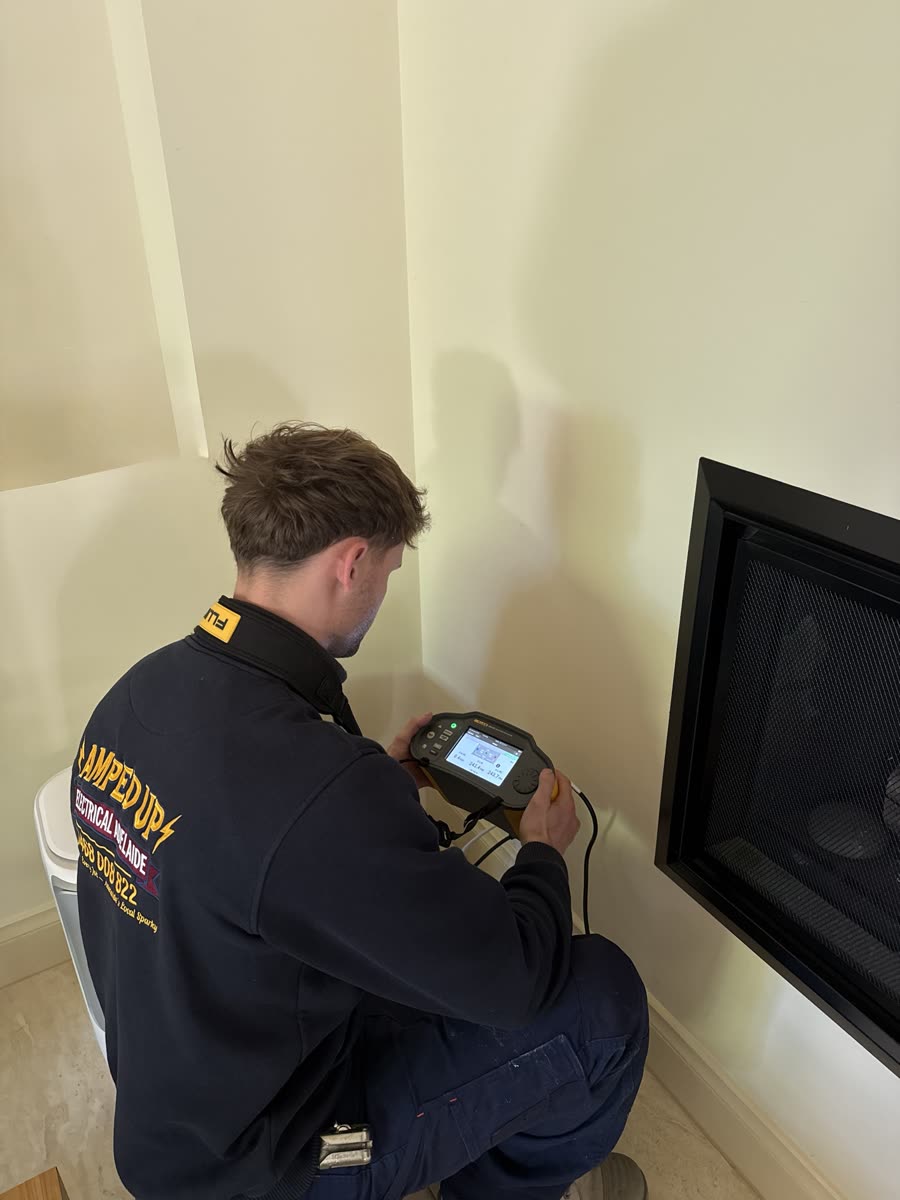
From there it's insulation resistance testing, earth loop impedance and continuity testing with a Fluke - not just switching things back on and hoping it holds. That's how I find an open neutral, a short, or leakage to earth that a reset alone will never fix.
Readings off the Fluke on a real job. Testing is what turns a guess into a diagnosis.
4. Thermal imaging, where it helps
On older boards or anywhere I suspect a loose connection, thermal imaging picks up a hot joint or an overloaded terminal without pulling the whole board apart to find it.
5. Fix the cause, not the symptom
Once I know what's actually wrong, I fix that - not just reset the switch and pack up. If your safety switch keeps tripping, it's doing exactly what it's meant to do: protecting you from a fault that's genuinely there. My job is to find it and put it right.
Faults I See Most in Adelaide Homes
Adelaide has a lot of housing stock from the 1920s through to the 1980s, and most of the faults I get called out for come straight out of that mix of old wiring and boards that have been added to over the years rather than replaced.
Loose or failed neutral connections, often in a roof-space junction box - one of the most common causes of a fault that comes and goes rather than staying put.
Rodent damage to cabling in the roof space - chewed insulation causing an earth leakage trip, especially in older weatherboard and villa homes.
Water getting into an outdoor light or power point - the safety switch trips every time it rains, then behaves perfectly the next dry week.
Original cotton or rubber-insulated wiring in 1920s-1950s homes, where the insulation has broken down after decades and starts leaking to earth.
Hot water systems tripping the safety switch, particularly on an older element.
Old ceramic fuse boards and rewirable fuses with no safety switch (RCD) protection at all - not a fault by itself, but the reason a real fault can go undetected for years.
Shared or interconnected neutrals across circuits, where a fault on one circuit trips a completely different one.
Corroded or loose connections at the main switchboard, usually from age, moisture, or a termination that was never quite tight.
A Few Recent Examples
Wattle Park, February 2026 - An intermittent safety-switch trip that had been going on for a while turned out to be rodent damage in the roof space, with cable insulation chewed through near a beam. Traced it back and replaced the damaged run through a proper junction box - hasn't tripped since.
Westbourne Park, September 2026 - A tripping lighting circuit that sounded simple on the phone turned into a proper fault find on site: damage to an outdoor light's supply cable, plus further damage to switch wiring in the roof space with bare conductors exposed. Not an emergency, just a fault that had been quietly getting worse. Fitted junction boxes, replaced the damaged cable, and tested the whole circuit before handing it back.
Prospect, June 2026 - A lighting circuit that only tripped when it rained, traced to water getting into an outdoor light fitting (a bird's nest nearby wasn't helping). Made the fitting safe, added proper safety-switch protection to the circuit, and it's been dry ever since.
What to Do Before I Arrive
A few things that help while you're waiting, and a couple worth avoiding:
Reset the safety switch once. If it trips again straight away, leave it off - repeatedly resetting it doesn't fix anything and can make the fault harder to trace.
Think about what was running when it tripped - a specific appliance, the weather, a light going on - and have that ready to tell me.
If you can identify the appliance that was on, unplug it and leave the rest of the house alone.
If only one circuit is affected, the rest of the board is usually fine to keep using normally.
If the board feels warm, smells like something's burning, or you can see scorch marks, turn the main switch off and don't touch anything else - leave that part for me on site.
Don't attempt any repair yourself. Electrical work in Australia has to be carried out by a licensed electrician.
When a Fault Is an Emergency
Most tripping and intermittent faults aren't dangerous - they're a nuisance that needs proper diagnosis, not a rush job. A few signs mean it genuinely can't wait: burning smells, sparking, a hot switchboard, exposed wiring, or water actually inside the switchboard itself. If that's what you're looking at, head straight to my 24/7 emergency electrician page instead of this one.
And if what a fault find actually turns up is a switchboard that's out of ways, still running old ceramic fuses, or needs a full rebuild rather than a repair, have a look at a switchboard upgrade - a fault find is often exactly where that conversation starts.
Real fault-finding calls — on video
Marcus films real jobs with Meta glasses — no actors, no stock footage. A couple of real fault-finding callouts, faults and all.
A safety switch (RCD) trips because it's detected current leaking somewhere it shouldn't - to earth, through water, or through a damaged appliance or cable. It's doing exactly what it's designed to do. Resetting it without finding the actual leak just means it'll trip again, sometimes straight away and sometimes days later.
One power point or light stopped working but nothing tripped - what's going on?
That's usually a loose or failed connection somewhere in the circuit rather than a leak to earth, which is why the safety switch doesn't react. It could be at the point itself, at a joint in the roof space, or back at the switchboard. I test the circuit to isolate exactly where the break is, rather than pulling out every point along the way.
How long does fault finding take?
It depends on the fault. Some are quick - isolate the circuit, find an obvious problem at the point or switch, fix it on the spot. Others take longer, especially anything involving a roof-space search for damaged cable or a fault that only shows up under certain conditions. I'll keep you updated on progress rather than disappearing into the roof space for hours without a word.
Will you fix it the same visit?
Often, yes - a lot of faults are a straightforward repair once they're found. If what I find points to something bigger, like a switchboard that needs replacing or damaged cable needing a proper rewire, I'll explain what I've found and quote the fix before doing any further work.
Why Choose Marcus?
Owner-Operated by Marcus
When you call about a fault, you're talking to me - not a call centre, not a subcontractor. I do the testing, the diagnosis and the repair myself, and I'll explain what I found and why in plain language before doing anything further.
Tripping switch, dead circuit, or something that comes and goes and you just can't pin down - I'll test it properly and find out what's actually wrong.